Why Your Brain Craves Paper (Even When Your Teacher is an AI)
The neuroscience behind why handwriting is still the king of learning, and why digital natives might be missing a trick.
“Wait, let me grab my pen.” A phrase that I often hear from my corporate students in the middle of a class.
At EIS Academy, we’re all about the future. Your classes are voice-driven, your feedback is instant, and your Session Reports are delivered to your dashboard with surgical precision. So why do my most sophisticated adult students still insist on keeping a physical notebook?
It’s not just a "Gen X" trait or a refusal to let go of the 90s. It’s actually brilliant neuroscience.
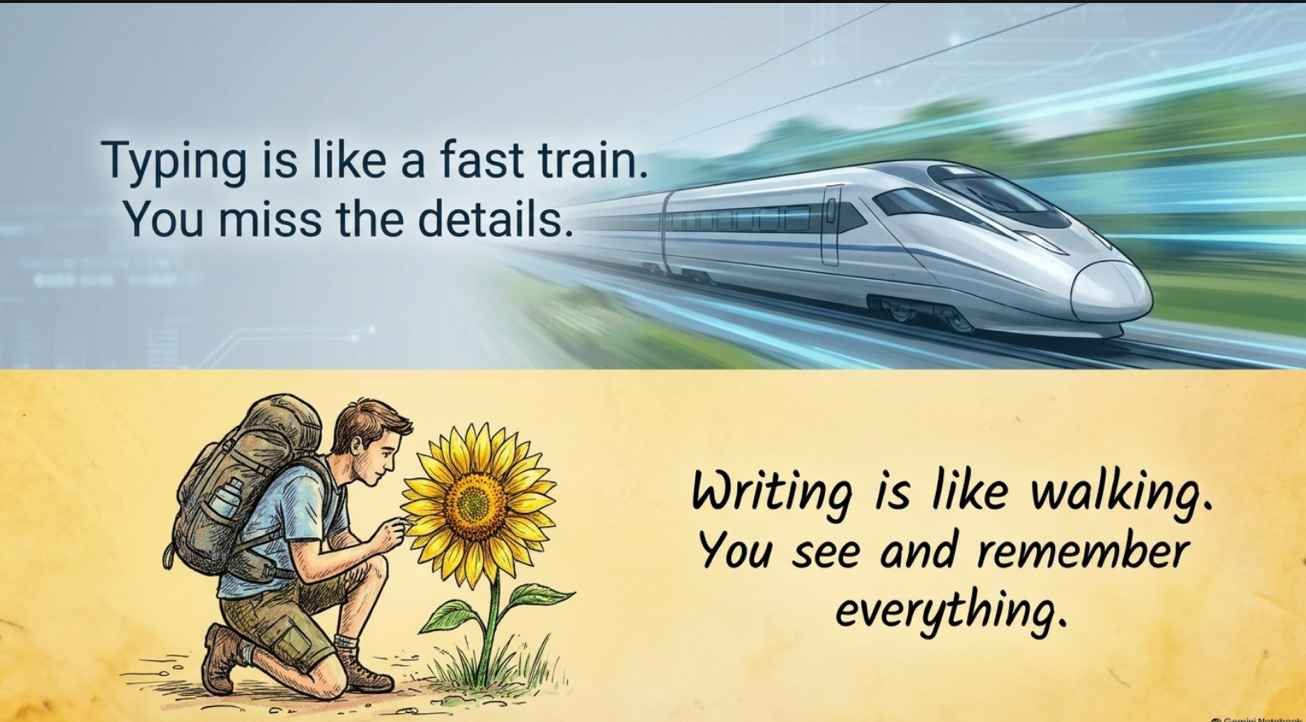
Why Typing is "Cheating"
If you’re a parent, you’ve probably seen how schools are desperately trying to keep kids writing by hand. There’s a reason for that. For a young student, handwriting isn't just about "learning letters"; it’s a foundational cognitive exercise.
When a kid writes on paper, they are engaging a complex motor-sensory loop. The brain has to plan the stroke, feel the resistance of the paper, and visualize the result. This process triggers the Reticular Activating System (RAS)—the brain’s "Priority Filter."
For adults, the effect is the same. When you type, your fingers perform the same repetitive motion for every letter. To your brain, "The" and "Cat" feel identical. But when you write by hand, your brain is forced to process the information twice: once to understand it, and once to physically manifest it.
Digital Natives vs. Analog Brains
While EIS Academy focuses on adults, there’s a lesson to be learned from the "iPad generation." Many young students today are fast typists but struggle with deep retention. Why? Because digital information is ephemeral. It’s "somewhere in the cloud."
The adult brain, however, thrives on spatial memory. You don’t just remember the word “nevertheless”; you remember that you wrote it in the top right corner of your notebook, right next to a smudge of ink. That physical "address" in your notebook acts as a mental GPS, making it much easier to recall the word during a presentation three weeks later.
Don't Be a Stenographer
Here is where my "experienced" side kicks in: The notebook is for your brain, not for the data.
I see some students trying to transcribe every word the AI says. Stop. You’re paying for a voice-first experience, not to become a 19th-century scribe.
In our platform, you already have:
- Full Transcripts: Every word spoken is recorded.
- Session Reports: Your mistakes and corrections are automatically categorized.
- PDF Downloads: You can save the "data" with one click.
If the AI is handling the "filing cabinet" part of your brain, your notebook should be for the "Aha!" moments.
The EIS Method for Paper Addicts
If you can't put down the pen, don't fight it. Use it strategically:
- The 3-Word Rule: Only write down the three most impactful words or phrases from your session. The ones that "clicked."
- Mnemonic Doodles: Draw a little icon next to a tricky preposition. Your brain loves images almost as much as it loves paper.
- The Post-Session Review: Use your physical notes to "bridge" the gap between your voice class and your Session Report.
In a world of infinite digital noise, your notebook is a quiet place where your brain actually does the work. Whether you’re 8 or 48, the pen remains the ultimate tool for telling your brain: "This matters. Keep it."
Just don't ask the AI to sharpen your pencil. It's still working on that.